Posts

Showing posts with the label twitter proof

Twitter proof: the roots go hand in hand

Pt En In this twitter proof we will have a look at a rather curious, yet simple, property of real polynomials. Claim: if $p(x) = \sum_{i=0}^n a_ix^i $ is a polynomial with real coefficients, then for all complex numbers $z $, $$p(z) = 0 \iff p(\bar{z}) = 0$$ which means that the complex roots of $p(x) $ come in conjugate pairs. Twitter proof: it suffices to show that $p(z) = 0 \implies p(\bar{z}) = 0$. Assume that $p(z) = 0$ and recall that $a_i = \bar{a_i} $: $$\begin{align} p(\bar{z}) &= \sum_{i=0}^n a_i\bar{z}^i \\ &= \sum_{i=0}^n \overline{a_iz^i} \\ &= \overline{\sum_{i=0}^n a_iz^i} = \overline{p(z)} = 0 \end {align} $$ Neste post vamos dar uma olhadela a uma propriedade curiosa, mas simples, dos polinómios com coeficientes reais. Proposição: se $p(x) = \sum_{i=0}^n a_ix^i $ é um polinómio com coeficientes reais, então para qualquer número complexo $z $ vem $$p(z) = 0 \iff p(\bar{z}) = 0$$ o que significa que as raízes complexas de $p(x) $ vêm...
Twitter proof: interpolating polynomials

Pt En In this post I will show the existence of a family of polynomials that are very useful for interpolation. For that I will use what are known as Lagrange polynomials. Claim: given $n+1$ pairs $(x_i, y_i) $ with $0\leq i \leq n $ and with $x_i \neq x_j $ whenever $i\neq j $, there exists a polynomial $p(x) $ of degree at most $n $ such that $$p(x_i) = y_i,\ i = 0, \cdots, n $$ Twitter proof: consider the polynomial $$l_i(x) = \prod_{j\neq i} \frac{x - x_j}{x_i - x_j} $$ with $l_i(x_i) = 1$ and $l_i(x_j) = 0$ whenever $j \neq i$. Define $p(x) $ to be $$p(x) = \sum_{i=0}^{n} y_i l_i(x) $$ $p(x) $ has degree at most $n $ because so do the $l_i(x) $ and $p(x_k) = \sum_i y_i l_i(x_k) = y_k $. In a future post I will show the uniqueness of the polynomial satisfying the constraints in the claim. Neste post vou mostrar a existência de uma família interessante de polinómios, muito útil em interpolação. Para isso vou usar uns polinómios chamados polinómios de Lagrange...

Twitter proof: irrational high-order roots of 2

Pt En For this twitter proof we will be using a piece of mathematics straight from the 17th century. Claim: the number $\sqrt[n]{2} $ is irrational for $n \geq 3$. Twitter proof: suppose that $n \geq 3$ and $\sqrt[n]{2}$ is rational, i.e. $\sqrt[n]{2} = \frac{a}{b}$ for some integers $a, b $. Then taking the $n $-th power of both sides we get $2 = \frac{a^n}{b^n} \iff b^n + b^n = a^n $, contradicting the well-known Fermat's Last Theorem . Para esta prova num tweet vamos usar um pedaço de matemática do século 17. Proposição: o número $\sqrt[n]{2} $ é irracional para $n \geq 3$. Prova num tweet: suponhamos que $n\geq 3$ e que $\sqrt[n]{2} $ é racional, i.e. $\sqrt[n]{2} = \frac{a}{b} $ para alguns inteiros $a, b $. Se for esse o caso, elevando os dois lados da igualdade a $n $, obtemos $2 = \frac{a^n}{b^n} \iff b^n + b^n = a^n $, contrariando o famoso Último Teorema de Fermat . &nbsp&nbsp- RGS join the mathspp mailing list

Twitter proof: the sum of inverses diverges

Pt En In this post I will share with you my favourite proof that the series of the inverses diverges: $\sum_{i=1}^\infty \frac1i = \infty $. Claim : the series $\sum_i \frac1i$ diverges. Twitter proof : consider the series $$ \begin{align} &\frac12 + \frac12 + \frac12 + \cdots = \\ &\frac12 + 2 \times\frac14 + 4\times \frac18 + \cdots = \\ &\frac12 + \frac14 + \frac14 + \frac18 + \cdots \leq \\ &\frac12 + \frac13 + \frac14 + \frac15 + \cdots \end{align}$$ that clearly diverges because it is a series of a constant nonzero term. By the comparison test, the series of the inverses also diverges. Comment with your favourite way to prove this fact!! Neste post quero partilhar com todos a minha prova preferida de que a série dos inversos dos naturais diverge: $\sum_{i=1}^\infty \frac1i = \infty $. Proposição : a série $\sum_i \frac1i$ diverge. Prova num tweet : considere-se a série$$ \begin{align} &\frac12 + \frac12 + \frac12 + \cdots = \\ &...

Twitter proof: the Tower of Hanoi

Image
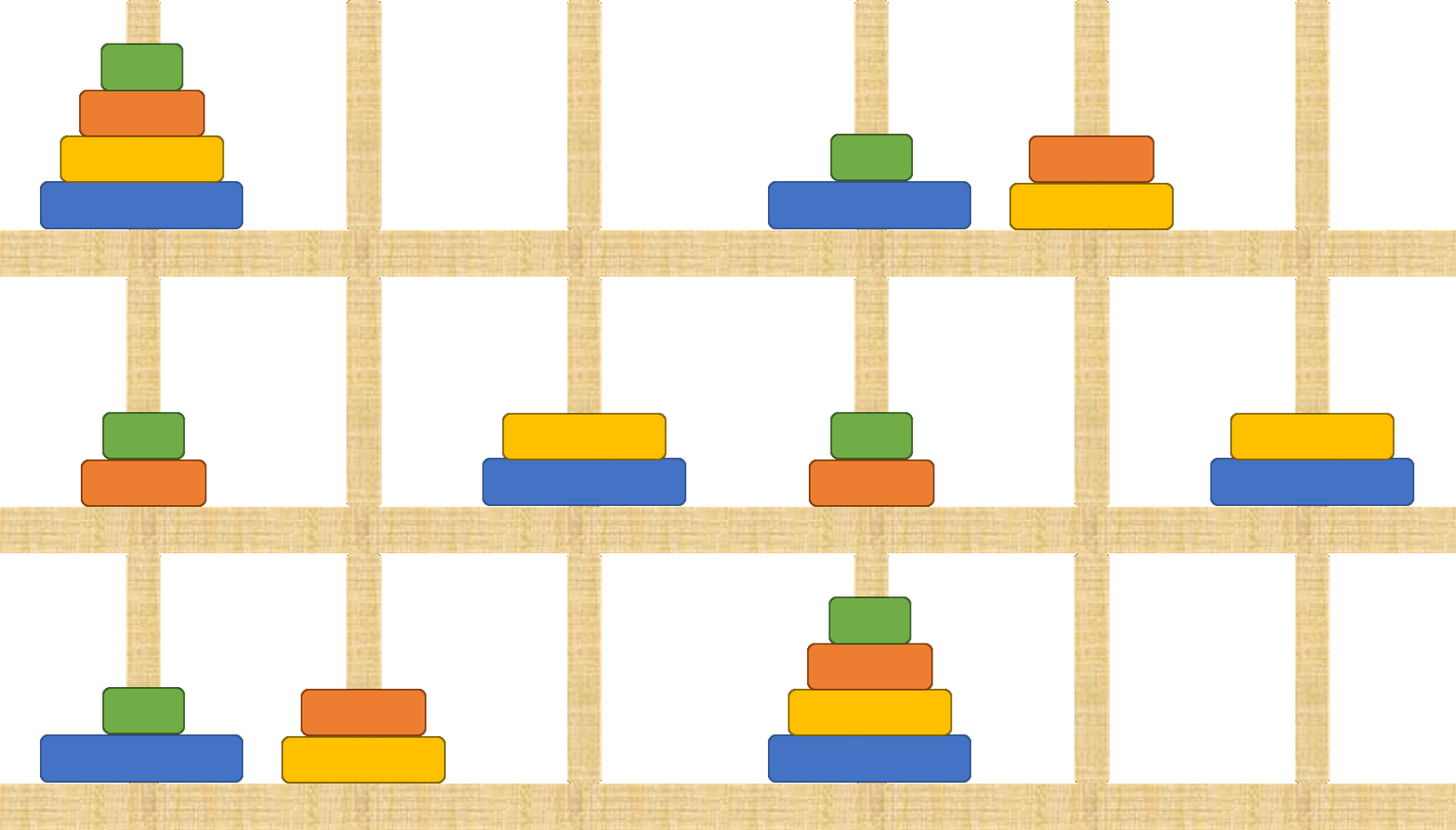
Pt En In this post we prove what the minimum number of moves to solve the problem of the Tower of Hanoi is! Claim: let $T(n)$ denote the number of moves it takes to solve the Tower of Hanoi with $n$ disks; then $T(n) = 2^{n}-1$. Twitter proof: note that to solve the problem with $n$ disks, we first have to move the top $n-1$ disks to one of the two poles, move the bottom disk (the bigger one) to the remaining pole, and then move the top $n-1$ disks to the top of the bigger disk. Each time we move the top $n-1$ disks to another pole we must take, at least, $T(n-1)$ moves (by definition of $T$) hence we clearly have $T(n) = 2T(n-1) + 1$. Just notice that $B(n) = 2^n - 1$ satisfies the recurrence relation and that $T(0) = B(0) = 0$. If you are having trouble understanding what I mean by to solve the problem with $n$ disks, we first have to move the top $n-1$ disks to one of the two poles, move the bottom disk (the bigger one) to the remaining pole, and then move t...

Twitter proof: not too hairy

Image
Pt En In this post I will show that some londoners share more than their native language and their propension to get sunburnt. For that we need to notice that there are more than $8.5$ million londoners and that the average human has $100,000$ hairs in the head. Assertion : there are, at least, $9$ londoners with the exact same number of hairs in their head. Twitter proof : given the facts above, there are more than $8$ million londoners with less than $1$ million hairs in their head. By the pigeonhole principle this means at least $9$ londoners have the exact same number of hairs. Neste post vamos mostrar que alguns londrinos partilham mais do que o inglês como língua materna e a propensão para apanhar escaldões. Para isso é preciso notar que há mais de $8.5$ milhões de londrinos e que o ser humano médio tem $100,000$ cabelos na sua cabeça. Asserção : há pelo menos $9$ londrinos com exatamente o mesmo número de cabelos na cabeça. Prova num tweet : pelos fac...

Twitter proof: infinite primes

Pt En The proof of this post is a very well known proof on the infinitude of primes. For the proof I am going to rephrase an argument used by Euclid more than $2000$ years ago. Theorem : there are infinitely many primes. Twitter proof : if $\mathcal{P} = \{p_1, \cdots, p_n\}$ is a finite set of primes, then the number $q = p_1\times\cdots\times p_n + 1$ is such that $q \not\in \mathcal{P}$. Either $q$ is prime or $q$ has a prime factor $q'$ that cannot be in $\mathcal{P}$, otherwise $q'$ would have to divide $1$. Hence, no finite set $\mathcal{P}$ can contain all primes. A prova deste post é uma prova conhecida da infinitude dos números primos. Para esta prova vou adaptar ligeiramente o argumento usado por Euclides há mais de $2000$ anos. Teorema : há infinitos números primos. Prova num tweet : se $\mathcal{P} = \{p_1,\cdots,p_n\}$ é um conjunto finito de primos, então o número $q = p_1\times\cdots\times p_n + 1$ é tal que $q \not \in \mathcal{P}$. Ou $q$...

Twitter proof: a terrible shoe shop

Image
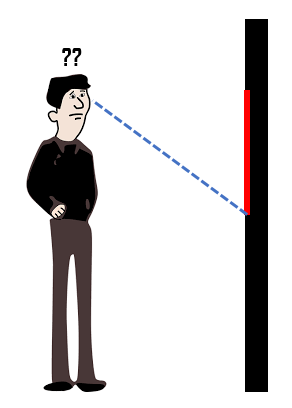
Pt En Neste post vou mostrar como a nossa intuição às vezes deixa escapar até as evidências geométricas mais simples... A prova prende-se com um problema real, ainda que pouco comum. Se formos a uma sapataria e experimentarmos uns sapatos novos, a maior parte das vezes vamos querer ver os nossos sapatos novos num espelho. Suponhamos então que, quando olhamos para o espelho na parede, o espelho está demasiado alto e não conseguimos ver abaixo dos nossos joelhos... O que é que devemos fazer a seguir? Damos um passo para a frente ou damos um passo para trás? Asserção : andar para a frente e andar para trás não faz diferença, se nos mantivermos com boa postura. Prova num tweet : para esta prova, uma imagem basta. Entendeste? Se sim, quero saber! Se não, eu explico! Basta deixar um comentário em baixo. In this post I will show how our intuition can be fooled, even by the simplest geometrical problems... The proof is related to a real-world problem, even though an unco...

Twitter proof: a solar system out of scale

Image
Pt En Há uns tempos ouvi dizer "não dá para ter um modelo do sistema solar à escala" . Achei piada ao que tinha ouvido e acreditei, mas não entendi bem a dimensão dessa afirmação. Vou usar um tweet para ajudar a dimensionar isto: Asserção: não se consegue levar um modelo do Sistema Solar, à escala, para uma feira de ciência da escola. Prova num tweet: o diâmetro de Mercúrio é menor que $5\times10^3km$ e a distância do Sol a Neptuno maior que $4.4\times10^9km$. Assim, se o Mercúrio do modelo tivesse $1mm$, a distância do Sol a Neptuno teria de ser maior que $8.8\times10^5mm = 0.88km$, quase um quilómetro. Some time ago I heard someone say "you can't have a miniature Solar System to scale" . I found it funny and I believed it, but I did not grasp the full meaning of that sentence. I will make use of a tweet to take care of that: Assertion: your science fair project cannot be a proportional model of the Solar System. Proof in a tweet: the ...