Posts

Showing posts with the label programming

DumbFire, a simple shooting game

Image
Pt En DumbFire is a very simple shooting game that I created with Python and pygame and you can find the code here . As of now, the game does not have a menu whatsoever nor it has any kind of instructions... (btw, to play it use the WASD keys to move and the space bar to shoot; if the coloured balls hit you, you lose health; if you shoot them, you get health back) I have been incredibly busy so I am not sure I will tidy this up any time soon but feel free to fork the repo in GitHub and to add different types of enemies and maybe some kind of power-up or whatnot. Actually, I would be very interested in hearing from you the answer to: if I could only add one single extra functionality to the game, what would that be? O jogo DumbFire é um jogo simplecíssimo de tiros que eu fiz com Python e com pygame. O código está no repo usual e convido-vos a fazerem uma cópia do mesmo para experimentarem alterar os tipos de inimigos, talvez juntar um ou outro power-up, etc. De mome...

Pledging to do 100 days of Machine Learning and progress log!

Image
Pt En It is a shame but I kind of dropped this when I was $41\%$ done... I hope I man up and finish this in the near future. After watching this video from Siraj Raval, I decided to jump right on board of the #100daysofMLcode initiative! (even though I am something like 73 days late...) The goal here is to devote (at least) 1h every day, for the next 100 days, to studying ML or writing code! According to the rules posted by Siraj, I must: Make a public pledge for this, which this post is; Make a log of everything, which this post will also be; Whenever I see something related to this #100DaysofMLCode, be supportive! Progress log For the day $0$ I wrote this post and spent quite some time thinking about what I will do throughout. I am thinking of studying several topics about ML and then writing educative posts here, for the blog. For today I wrote this twitter proof , tackling a mathematical property of neural networks with linear activation functions. ...

MatchWalker, a puzzle game of shape and colour

Image
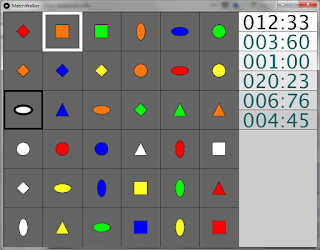
Pt En In today's post I will be sharing a game I made with just under $400$ lines in Processing, a wrapper for Java that makes drawing to the screen really easy. The goal of the game is really simple: go from the cell you are standing on (marked with the black outline of the ellipse, in the screenshot) to the cell that is framed in white. To do that, you can move a "cursor" (the black frame) with the $AWSD$ keys to choose the next cell you want to go to. To move, press the space bar. There are a couple of rules to moving, though: You can only move to the selected cell if it is in the same row or same column as the cell you are in; You can only move to the selected cell if it has the same colour or the same shape as the cell you are in. Rule number $1$ says you can only go in the directions these orange arrows cover: Rule number $2$ says that, from the cells specified by the above rule, you can only go to the white circle, diamond or vertical el...

Teaching a robot how to vacuum clean with genetic algorithms!

Image
Pt En < change language In this post I want to showcase the beginning of what I think will be a really cool project. After reading a really nice book (that Bill Gates himself recommends) on machine learning, I decided to experiment with genetic algorithms. For that matter, the main goal here will be to develop a genetic algorithm that teaches a vacuum cleaner how it should move in a dirty room to clean it in the best way possible (that is what is happening in the animation above). The first step is to define what I mean by room : a room will be a rectangular grid where each cell has a number from $0$ to $1$. A cell with a $0$ is perfectly clean and a cell with a number $1$ is as dirty as a piece of floor can get. Below we see a $5\times 5$ room with a robot (in red) already in the middle of the room: As I read in The Master Algorithm (and frankly I found it very enlightening), when one is going to use genetic algorithms we must previously define the structu...

Random maze generation

Image
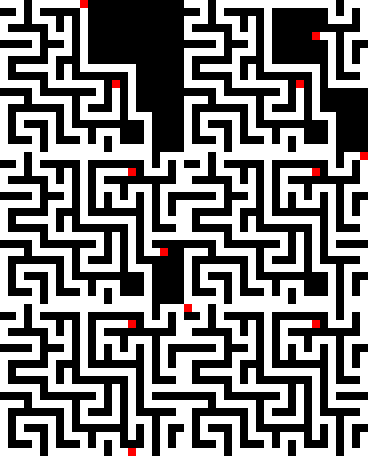
Pt En In this post I just want to share a simple algorithm that I used to create random mazes. The idea came from an e-mail I got, about a past competition, where one of the contestants did this exact thing: a program to generate random mazes. I saw the animation of the program working here and I deduced how to do it. All the code can be found on GitHub , as well as an executable of the program, the animations from the beginning and end of this post, an image of a bigger maze, and this other animation: where you can see a different style of maze; a less straight one. The maze starts in the top left red corner and ends wherever the other red square is, which need not be on the bottom right corner. The algorithm is simple: travel randomly inside the black area without ever hitting a white path; whenever no random move can be made, start going back until you find a place where the path can branch out again. While we are creating white paths, keep updating the fin...

Square roots by hand (and Newton's method)

Image
Pt En Na primária aprendemos a fazer somas, subtrações, multiplicações e divisões; o que nunca nos ensinam é a calcular raízes quadradas. Existe um algoritmo (não muito simples) para calcularmos raízes quadradas à mão, mas muitas vezes uma boa aproximação chega-nos. Acontece também que para o caso das raízes quadradas existe um truque muito simples que pode ser explicado com geometria, e esse truque produz aproximações muito boas! O que veremos mais adiante é que esse truque está relacionado com um método mais geral para resolver equações. Para explicar o truque vamos aplicá-lo diretamente. Vamos tentar encontrar a raíz quadrada de $7373$. A primeira coisa a fazer é arranjar um palpite. Quanto melhor for o palpite inicial, melhores vão ser as aproximações, mas não é preciso um palpite muito bom para que as aproximações sejam satisfatórias! Sei que $80^2 = 6400$ e $90^2 = 8100$ e $7373$ está mais ou menos no meio, portanto posso tomar $85$ como palpite inicial. Se quiserm...

Tutorial on programming a memory card game

Image
Pt En Este post vai ser um tutorial, não muito detalhado, sobre como fazer um jogo de memória com Python e pygame. O jogo que vamos implementar é um jogo comum: viramos uma série de cartas para baixo e temos que as virar duas a duas, tentando encontrar os pares. Claro que quando viramos duas cartas que não são um par, temos de as voltar de novo para baixo. Quando estou a criar um jogo, gosto de o ir desenvolvendo por etapas funcionais: partir o processo em várias fases que representem pontos nos quais eu tenho algo que posso testar. Deste modo, não só o processo se torna muito mais interessante, como posso ir controlando o aspeto do que estou a produzir. Deixo de seguida uma lista das etapas que eu pensei para este projeto; cada ponto da lista descreve a funcionalidade que o jogo já suporta: Criar um ecrã onde mostro todas as cartas dispostas, face para baixo; Clicar em cima de uma carta faz com que ela se vire para cima; Clicar na segunda carta verifica se encontrei...