Posts

Showing posts with the label construction

Twitter proof: interpolating polynomials

Pt En In this post I will show the existence of a family of polynomials that are very useful for interpolation. For that I will use what are known as Lagrange polynomials. Claim: given $n+1$ pairs $(x_i, y_i) $ with $0\leq i \leq n $ and with $x_i \neq x_j $ whenever $i\neq j $, there exists a polynomial $p(x) $ of degree at most $n $ such that $$p(x_i) = y_i,\ i = 0, \cdots, n $$ Twitter proof: consider the polynomial $$l_i(x) = \prod_{j\neq i} \frac{x - x_j}{x_i - x_j} $$ with $l_i(x_i) = 1$ and $l_i(x_j) = 0$ whenever $j \neq i$. Define $p(x) $ to be $$p(x) = \sum_{i=0}^{n} y_i l_i(x) $$ $p(x) $ has degree at most $n $ because so do the $l_i(x) $ and $p(x_k) = \sum_i y_i l_i(x_k) = y_k $. In a future post I will show the uniqueness of the polynomial satisfying the constraints in the claim. Neste post vou mostrar a existência de uma família interessante de polinómios, muito útil em interpolação. Para isso vou usar uns polinómios chamados polinómios de Lagrange...

Twitter proof: the sum of inverses diverges

Pt En In this post I will share with you my favourite proof that the series of the inverses diverges: $\sum_{i=1}^\infty \frac1i = \infty $. Claim : the series $\sum_i \frac1i$ diverges. Twitter proof : consider the series $$ \begin{align} &\frac12 + \frac12 + \frac12 + \cdots = \\ &\frac12 + 2 \times\frac14 + 4\times \frac18 + \cdots = \\ &\frac12 + \frac14 + \frac14 + \frac18 + \cdots \leq \\ &\frac12 + \frac13 + \frac14 + \frac15 + \cdots \end{align}$$ that clearly diverges because it is a series of a constant nonzero term. By the comparison test, the series of the inverses also diverges. Comment with your favourite way to prove this fact!! Neste post quero partilhar com todos a minha prova preferida de que a série dos inversos dos naturais diverge: $\sum_{i=1}^\infty \frac1i = \infty $. Proposição : a série $\sum_i \frac1i$ diverge. Prova num tweet : considere-se a série$$ \begin{align} &\frac12 + \frac12 + \frac12 + \cdots = \\ &...

To measure or not to measure... a real problem!

Image
Pt En This post will be more theoretical than usual. If you are afraid of mathematics, go away now before it is too late! I will write about a set, the Vitali set, which arises in measure theory , to show that there is no coherent way of assigning a size to every subset of the real line. Because of that I will try to define size for subsets of the real line and then verify that such task is impossible. I will also enforce a couple of (seemingly reasonable) restrictions on my definition. I challenge you to read this post and to calmly follow my reasoning. Whenever something doesn't seem obvious, try to make it clear by yourself with a piece of paper and pen/pencil. If any doubts persist, drop me your question(s) in the comments and I will answer gladly! Let us call $m$ to the function that, given a subset of the real line, returns its size; that is, let us try to define $m: \mathcal{P}(\mathbb{R}) \to [0, \infty]$. Let us also suppose that the function $m$ sat...

How to compute any square root by hand

Image
Pt En Num post anterior mostrei como podemos aproximar a raíz quadrada de um número através de um processo iterativo que começa com um palpite, seguido de vários ajustes. Neste post vou mostrar qual é o algoritmo mencionado pela Mathgurl no vídeo que ela fez em "parceria" comigo. O método que vou descrever pode ser usado com qualquer número real, seja quadrado perfeito ou não, seja inteiro ou não, racional ou não. Vou começar por apresentar um raciocínio que mostra como o algoritmo surge. Para quem não estiver interessado, pode saltar diretamente para a explicação final de como funciona . Para a exposição que se segue, se $a,b$ forem dígitos, então a notação $ab$ representa o número $10a + b$ em vez do número $a\times b$. Começamos por notar que, se quisermos descobrir $\sqrt{N}$ à mão e $\sqrt{N}$ for irracional, então vamos ter de nos contentar com uma aproximação com um número finito de casas decimais. Por outro lado, se $\sqrt{N} = a_0a_1\cdots a_n.b_0\c...

The naturals, the rationals and sets that fit inside themselves

Image
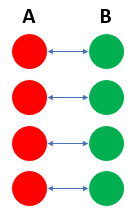
Pt En If I have two groups of kids in front of me, for example two different classes, how can I decide if the two groups have the same size? Of course I can count both groups, but I can also ask every kid from group $A$ to give his hand to a kid from group $B$, so they pair up. If, in the end, everyone is paired up, both groups have the same size. If some kid from group $A$ doesn't manage to give his hand to anybody, because every kid from group $B$ is taken, then the group $A$ had more kids... and if some kid from group $B$ doesn't get the hand from any kid from group $A$, then group $B$ had more kids! When we want to compare the sizes of two sets this is one of the things we can do! Instead of counting the two sets, we can try to pair them up. If we manage to do that, the sets have the same size! Sometimes pairing two sets is a hard task and instead we opt for a different thing: remember that if $a \leq b$ and $b \leq a$ then $a=b$; hence, if a set $A$ is not s...