Posts

Showing posts with the label cardinality

To measure or not to measure... a real problem!

Image
Pt En This post will be more theoretical than usual. If you are afraid of mathematics, go away now before it is too late! I will write about a set, the Vitali set, which arises in measure theory , to show that there is no coherent way of assigning a size to every subset of the real line. Because of that I will try to define size for subsets of the real line and then verify that such task is impossible. I will also enforce a couple of (seemingly reasonable) restrictions on my definition. I challenge you to read this post and to calmly follow my reasoning. Whenever something doesn't seem obvious, try to make it clear by yourself with a piece of paper and pen/pencil. If any doubts persist, drop me your question(s) in the comments and I will answer gladly! Let us call $m$ to the function that, given a subset of the real line, returns its size; that is, let us try to define $m: \mathcal{P}(\mathbb{R}) \to [0, \infty]$. Let us also suppose that the function $m$ sat...
The naturals, the rationals and sets that fit inside themselves

Image
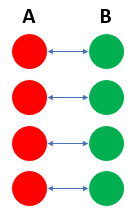
Pt En If I have two groups of kids in front of me, for example two different classes, how can I decide if the two groups have the same size? Of course I can count both groups, but I can also ask every kid from group $A$ to give his hand to a kid from group $B$, so they pair up. If, in the end, everyone is paired up, both groups have the same size. If some kid from group $A$ doesn't manage to give his hand to anybody, because every kid from group $B$ is taken, then the group $A$ had more kids... and if some kid from group $B$ doesn't get the hand from any kid from group $A$, then group $B$ had more kids! When we want to compare the sizes of two sets this is one of the things we can do! Instead of counting the two sets, we can try to pair them up. If we manage to do that, the sets have the same size! Sometimes pairing two sets is a hard task and instead we opt for a different thing: remember that if $a \leq b$ and $b \leq a$ then $a=b$; hence, if a set $A$ is not s...