Posts

Showing posts with the label integers

Twitter proof: infinite primes

Pt En The proof of this post is a very well known proof on the infinitude of primes. For the proof I am going to rephrase an argument used by Euclid more than $2000$ years ago. Theorem : there are infinitely many primes. Twitter proof : if $\mathcal{P} = \{p_1, \cdots, p_n\}$ is a finite set of primes, then the number $q = p_1\times\cdots\times p_n + 1$ is such that $q \not\in \mathcal{P}$. Either $q$ is prime or $q$ has a prime factor $q'$ that cannot be in $\mathcal{P}$, otherwise $q'$ would have to divide $1$. Hence, no finite set $\mathcal{P}$ can contain all primes. A prova deste post é uma prova conhecida da infinitude dos números primos. Para esta prova vou adaptar ligeiramente o argumento usado por Euclides há mais de $2000$ anos. Teorema : há infinitos números primos. Prova num tweet : se $\mathcal{P} = \{p_1,\cdots,p_n\}$ é um conjunto finito de primos, então o número $q = p_1\times\cdots\times p_n + 1$ é tal que $q \not \in \mathcal{P}$. Ou $q$...
The naturals, the rationals and sets that fit inside themselves

Image
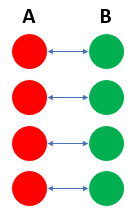
Pt En If I have two groups of kids in front of me, for example two different classes, how can I decide if the two groups have the same size? Of course I can count both groups, but I can also ask every kid from group $A$ to give his hand to a kid from group $B$, so they pair up. If, in the end, everyone is paired up, both groups have the same size. If some kid from group $A$ doesn't manage to give his hand to anybody, because every kid from group $B$ is taken, then the group $A$ had more kids... and if some kid from group $B$ doesn't get the hand from any kid from group $A$, then group $B$ had more kids! When we want to compare the sizes of two sets this is one of the things we can do! Instead of counting the two sets, we can try to pair them up. If we manage to do that, the sets have the same size! Sometimes pairing two sets is a hard task and instead we opt for a different thing: remember that if $a \leq b$ and $b \leq a$ then $a=b$; hence, if a set $A$ is not s...

A layman's introduction to groups

(An english translation of this post can be found after the portuguese version, here ) O objetivo deste post é introduzir o conceito de grupo de uma maneira que seja entendível por um aluno do secundário. Os grupos são objetos matemáticos cuja utilidade advém do nível de abstração que representam, em relação aos objetos matemáticos mais usuais, tais como: os números inteiros, racionais e reais ($\mathbb{Z}, \mathbb{Q}, \mathbb{R}$); as funções (reais de variável real) com a soma usual e composição de funções ($f \circ g$); rotações e simetrias de polígonos regulares. Tentaremos também justificar a importância da noção de grupo através de alguns resultados (simples) que provam a utilidade de considerar objetos abstratos. Supõe-se que o leitor está minimamente familiarizado com os objetos da lista anterior, uma vez que uma das maneiras mais fáceis de introduzir a noção de grupo é ir comparando a teoria abstrata com objetos concretos e comuns. Começamos por apresentar a defin...