Posts

Showing posts with the label java

MatchWalker, a puzzle game of shape and colour
Image
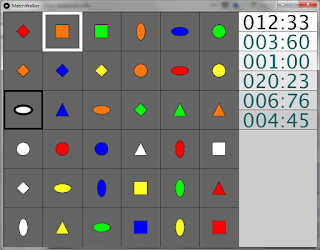
Pt En In today's post I will be sharing a game I made with just under $400$ lines in Processing, a wrapper for Java that makes drawing to the screen really easy. The goal of the game is really simple: go from the cell you are standing on (marked with the black outline of the ellipse, in the screenshot) to the cell that is framed in white. To do that, you can move a "cursor" (the black frame) with the $AWSD$ keys to choose the next cell you want to go to. To move, press the space bar. There are a couple of rules to moving, though: You can only move to the selected cell if it is in the same row or same column as the cell you are in; You can only move to the selected cell if it has the same colour or the same shape as the cell you are in. Rule number $1$ says you can only go in the directions these orange arrows cover: Rule number $2$ says that, from the cells specified by the above rule, you can only go to the white circle, diamond or vertical el...

Teaching a robot how to vacuum clean with genetic algorithms!

Image
Pt En < change language In this post I want to showcase the beginning of what I think will be a really cool project. After reading a really nice book (that Bill Gates himself recommends) on machine learning, I decided to experiment with genetic algorithms. For that matter, the main goal here will be to develop a genetic algorithm that teaches a vacuum cleaner how it should move in a dirty room to clean it in the best way possible (that is what is happening in the animation above). The first step is to define what I mean by room : a room will be a rectangular grid where each cell has a number from $0$ to $1$. A cell with a $0$ is perfectly clean and a cell with a number $1$ is as dirty as a piece of floor can get. Below we see a $5\times 5$ room with a robot (in red) already in the middle of the room: As I read in The Master Algorithm (and frankly I found it very enlightening), when one is going to use genetic algorithms we must previously define the structu...

Generalized Sudoku (jigsaw sudoku)

Image
Pt En Muita gente sabe o que é um sudoku: um puzzle com números que se joga numa tabela com $9$ linhas e $9$ colunas. O objetivo é simples: preencher a tabela com os números entre $1$ e $9$, seguindo umas quantas regras. As regras que devem ser seguidas não são complicadas, mas quem já experimentou resolver sudokus sabe que às vezes pode ser bastante difícil completar o puzzle! Para além de resolver problemas, os matemáticos também gostam muito de generalizar . Suponhamos que temos uma série de características e que olhamos para todos os objetos que satisfazem essas restrições; uma generalização desses objetos pode ser dada ao ignorarmos uma das características consideradas. A título de exemplo, suponha-se que estamos à procura de todos os polígonos que satisfazem as seguintes restrições: Tem quatro lados; Todos os lados são iguais; Todos os lados fazem ângulos de $90^\circ$ entre si. É fácil de ver que o quadrado é o único polígono que satisfaz estas duas retr...